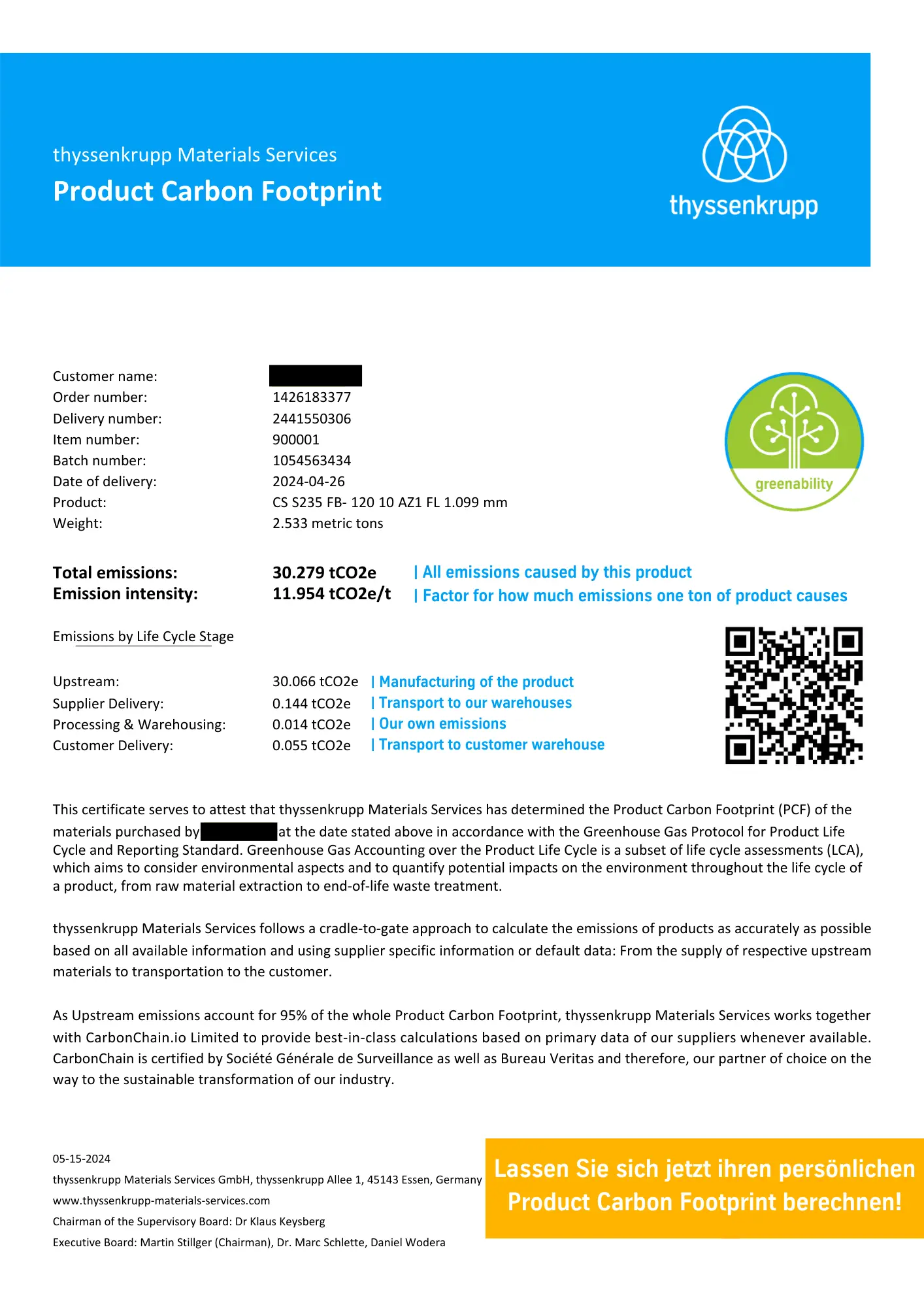
Accurate and reliable carbon footprint with our expert tools
Transparency about your carbon footprint is essential for achieving environmental goals. Accurate data plays a crucial role here.
We offer you high-quality Product Carbon Footprints (PCFs) and comprehensive services. With our reports and declarations, we enable you to understand your carbon footprint and make decisions to reduce greenhouse gas emissions along your value chain. Our data quality is of the highest possible standard.
The Carbon Footprint as a basis for sustainable purchasing decisions
Companies that disclose their carbon footprint set themselves apart from the competition. After all, sustainability and environmental awareness are decisive factors in modern industrial production. A product carbon footprint (PCF) can help to fulfil legal requirements and prepare for future environmental regulations. The calculation of emissions will become a necessary standard in the coming years in order to fulfil EU directives such as CBAM, CSRD, CSDDD and the Supply Chain Duty of Care Act (LkSG). Discover the benefits of our PCF reports at thyssenkrupp Materials Europe and improve your company's CO2 transparency. Our PCFs provide full transparency on the CO2 emissions of your products, creating trust with customers and partners. With the Cradle to Gate approach, we follow the Greenhouse Gas Protocol, one of the most internationally recognised and widely used standards for calculating emissions.
Discover the benefits of our PCF reports at thyssenkrupp Materials Europe and enhance your company's CO2 transparency.
How is a Product Carbon Footprint report structured?
Our PCF report
Our Product Carbon Footprint report offers detailed insights into your product's carbon footprint. The PCF report covers a specified period and analyzes each phase of the product lifecycle, in which all orders are accumulated, using the Cradle-to-Gate approach.
Use our PCF calculator to enhance your sustainability strategies with accurate calculations.
Reporting obligations for companies under the EU sustainability regulations
From 2022: EU taxonomy
Publicly listed companies
Companies with more than 500 employees from the general economy, the financial sector and the insurance industry will be required to report to the EU taxonomy for the first time from 2022.
Börsennotierte Unternehmen
Companies with more than 500 employees from the general economy, the financial sector and the insurance industry are obliged to submit an initial report on EU taxonomy capability and alignment from 2023.
From 2024: CSRD
From 2024: CBAM
Publicly listed companies
Companies with more than 500 employees from the general economy, the financial sector and the insurance industry are obliged to submit an initial report on EU taxonomy capability, alignment and CSRD from 2024.
Companies that fulfil 2 out of 3 criteria (more than 250 employees / more than 50 million euros turnover / more than 25 million euros total assets)
must submit a first-time report on the EU Taxonomy & CSRD from 2025.
Ab 2026: CSDDD
Companies that fulfil 2 out of 3 criteria (more than 250 employees / more than 50 million euros turnover / more than 25 million euros total assets)
must submit their first reporting on the EU taxonomy, CSRD and CSDDD from 2026.
Listed small and medium-sized enterprises
must report in accordance with all guidelines for the first time from 2026.
Sustainable supply chain optimisation with greenability services
Innovative consulting for sustainable success. Transitioning to sustainability can be challenging for material-intensive industries due to technical barriers and costly eco-friendly materials and processes. We offer support in incorporating sustainable practices, reducing risks, and enhancing economic efficiency with tailored solutions to boost your sustainability objectives